Landline Phone:
(413) 214-6541
Location:
15 Agawam Ave West Springfield, MA 01089
Mon - Fri:
8.00am - 4.00pm
Cooling Tower Water Testing & Analysis Services
Related Posts
In the complex ecosystem of Industrial Water Analysis, cooling towers represent one of the most chemically volatile environments. As water evaporates to reject heat, the minerals left behind concentrate rapidly, creating a “perfect storm” for equipment failure. Sterling Analytical provides the high-precision testing required to manage this volatility, ensuring your cooling system remains efficient, safe, and compliant.
A cooling tower is essentially a massive air scrubber. It pulls in dust, pollen, and bacteria while concentrating dissolved solids like Calcium and Silica. Without rigorous monitoring, these factors lead to the “Triple Threat” of cooling water: Scale, Corrosion, and Biofouling. Our laboratory provides the analytical backbone for water treatment professionals, helping them balance chemical dosing with water conservation goals.
The "Triple Threat": Why Cooling Water Fails
Sterling Analytical focuses on the three primary failure modes that can cripple an industrial cooling system.
1. Mineral Scaling (The Efficiency Killer)
As water evaporates, minerals like Calcium Carbonate ($CaCO_3$) and Silica ($SiO_2$) exceed their solubility limits. They precipitate out of the water and form a hard, rock-like layer on heat exchange surfaces.
The Heat Transfer Penalty: Scale is an incredibly poor conductor of heat. Even a microscopic layer (0.005 inches) can reduce chiller efficiency by 10%, leading to massive spikes in electricity costs.
Our Analysis: We calculate the Langelier Saturation Index (LSI) and the Ryznar Stability Index (RSI). These indices tell us if your water is “scale-forming” or “corrosive” before the damage occurs.
2. Corrosion (The Equipment Destroyer)
Cooling water is naturally corrosive because it is saturated with oxygen and often contains high levels of “aggressive ions” like Chlorides and Sulfates.
Pitting Corrosion: This localized attack can “drill” a hole through a stainless steel heat exchanger in a matter of weeks.
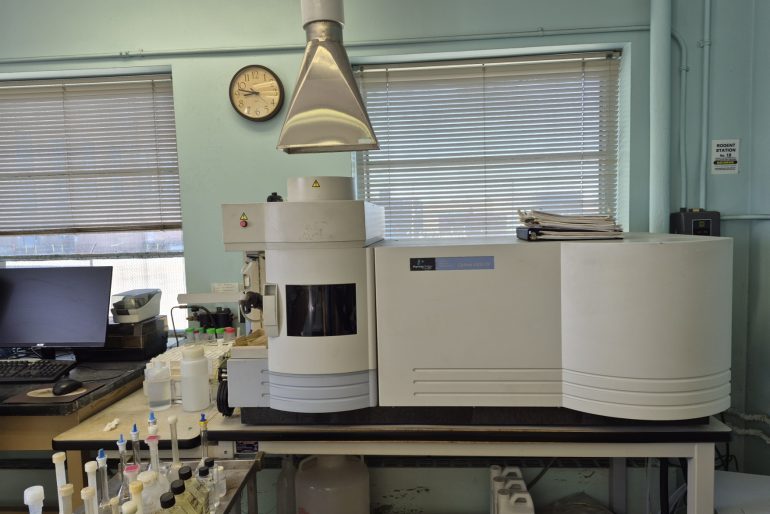
Indicator Metals: We utilize Heavy Metals Testing (ICP-OES) to monitor for Iron, Copper, and Zinc. A sudden spike in Copper indicates that your “yellow metal” corrosion inhibitors (like Azoles) have failed, and your chiller tubes are dissolving.
3. Biofouling & Legionella (The Health & Safety Risk)
Warm, nutrient-rich, and oxygenated water is the ideal breeding ground for algae, fungi, and bacteria—most notably Legionella pneumophila.
Biofilm Insulation: Biological “slime” is actually a better insulator than mineral scale, meaning it kills efficiency even faster.
Compliance: We provide specialized Legionella Culture Testing in accordance with ASHRAE Standard 188 to protect your facility from legal liability and public health crises.
Cycles of Concentration (CoC)
The most critical calculation in Industrial Water Analysis for cooling systems is the Cycles of Concentration. This is the ratio of the concentration of a specific ion (usually Chloride or Magnesium) in the tower water versus the make-up water.
$$CoC = \frac{\text{Concentration in Tower Water}}{\text{Concentration in Make-up Water}}$$
The Economic Balance
Low Cycles (e.g., 2.0): You are discharging too much water (Blowdown). This wastes expensive chemicals and increases your water utility bill.
High Cycles (e.g., 6.0): You are saving water, but the risk of catastrophic scaling is extremely high.
The “Sweet Spot”: Sterling Analytical provides the precise ion-balancing needed to find your system’s maximum safe CoC, often allowing facilities to save millions of gallons of water annually.
Engineering Impact: ROI and System Longevity
Our data is used by facility engineers to drive three key outcomes:
Water Conservation: By accurately measuring the scaling threshold, we help facilities safely increase their CoC, which is a major component of LEED and corporate sustainability goals.
Energy Efficiency: Keeping heat exchanger surfaces clean ensures the chiller compressor doesn’t have to work harder to achieve the same cooling tonnage.
Chemical Optimization: Instead of “slug dosing” chemicals based on a calendar, our data allows for “Demand-Based Dosing,” which can reduce chemical spend by 15-20%.
Problems Identified
Inhibitor Depletion: Detecting when phosphate-based inhibitors are being “consumed” by scale formation rather than protecting the metal.
Make-up Water Shifts: Identifying when municipal water chemistry changes (e.g., switching from well water to surface water), which requires an immediate change in tower treatment.
Galvanic Corrosion: Identifying high Copper levels that can “plate out” on steel surfaces, causing rapid localized corrosion.
Process Leaks: Detecting high TOC (Total Organic Carbon) that suggests a process fluid is leaking into the cooling loop, providing “food” for bacteria.
How to Submit a Sample
Sample Locations: Always take samples from the Recirculating Pump Discharge or the Tower Basin (away from the make-up inlet). Also, provide a sample of the Make-up Water for CoC calculations.
Sample Volume: 500mL to 1 Liter in a clean HDPE bottle.
Preservation: Do not acid-preserve samples intended for LSI/Alkalinity testing. For metals analysis, a separate nitric-acid-preserved vial is required.
Bio-Testing: Samples for bacteria/Legionella must be collected in sterile containers containing a de-chlorinating agent (Sodium Thiosulfate) and shipped overnight on ice.
Optimize Performance with Cooling Tower Water Testing & Analysis
Sterling Analytical provides advanced testing and analysis of cooling tower water, delivering the critical data needed to maintain system efficiency, control scaling and corrosion, and prevent biological growth. Our comprehensive laboratory services support effective water treatment programs and operational reliability.
With NIST-traceable results, we help facility managers, plant operators, and environmental specialists optimize chemical usage, reduce maintenance costs, and ensure compliance with industry standards.
Take the next step with our expert laboratory services:
Frequently Asked Questions
For most industrial systems, a full laboratory analysis should be performed monthly. High-stress systems or those using "grey water" for make-up may require weekly testing.
The Langelier Saturation Index (LSI) is a "Yes/No" indicator of whether water will scale. The Ryznar Stability Index (RSI) is more accurate for predicting the severity of that scale or corrosion in high-temperature industrial applications.
Yes. "Blowdown" water can often be treated and used for irrigation or as make-up for Boiler Water Testing systems, provided the chemical residuals are managed.
If your cooling tower "drifts" or leaks, the chemicals (like Zinc or Phosphates) can enter the storm drain system, potentially causing an NPDES permit violation.
Quick Contact
If you have any questions or need help, feel free to contact with our team.
Send Us Email:
Call Us Today: