Material Compatibility Testing
Landline Phone:
(413) 214-6541
Location:
15 Agawam Ave West Springfield, MA 01089
Mon - Fri:
8.00am - 4.00pm
Chemical Compatibility Testing: The Root Cause of Particulate Contamination
Related Posts
In the world of high-purity manufacturing, “Cleanliness” is often treated as a surface-level issue—something to be solved with better filters or more frequent rinsing. However, at Sterling Analytical, we have found that a significant percentage of particulate and residue failures are actually symptoms of a deeper problem: Chemical Incompatibility.
When a process fluid, cleaning agent, or lubricant is chemically incompatible with a system’s seals, gaskets, or piping, the material doesn’t just “fail” in a mechanical sense. It undergoes a chemical transformation that generates Particulates (shedding), Non-Volatile Residues (leaching), and Precipitates (chemical fallout). Chemical Compatibility Testing is the forensic process of ensuring that your materials and fluids can coexist without compromising the cleanliness of your final product.
1. The "Invisible" Link: How Incompatibility Creates Contamination
To maintain a “Class 100” cleanroom or a “Zero-Particulate” pharmaceutical line, one must understand the three ways chemical incompatibility generates contamination:
A. Elastomeric Shedding (Particulate Generation)
When an O-ring or gasket is exposed to an incompatible solvent, it often undergoes “Swelling” followed by “Micro-Fissuring.” As the polymer chains break down, the surface of the seal becomes friable.
The Result: Microscopic “black specks” or “elastomeric fines” are shed into the process stream. These are often the most common particulates found in hydraulic and pharmaceutical systems.
The Test: We perform long-term immersion followed by SEM-EDS to identify the chemical signature of the shed particles.
B. Plasticizer Leaching (NVR Generation)
Many flexible plastics (like PVC or certain TPEs) rely on “Plasticizers” to stay pliable. If a process fluid is a strong enough solvent, it will “extract” these plasticizers from the bulk material.
The Result: The fluid becomes contaminated with Non-Volatile Residue (NVR). This residue can later “plate out” on sensitive components, creating a sticky film that traps other abrasives.
The Test: We use FTIR Spectroscopy to “fingerprint” the residue and match it back to the source material.
C. Chemical Precipitation (The "Fallout")
Sometimes, the material and the fluid are fine individually, but the interaction between the two creates a new, insoluble solid. For example, a cleaning agent might react with a specific metal alloy to form an insoluble metal salt.
The Result: A “cloudy” fluid or a fine “white powder” residue that clogs sub-micron filters.
The Test: We utilize ICP-OES to detect metal ions in the fluid and X-Ray Diffraction (XRD) to identify the crystalline structure of the precipitate.
2. Primary Failure Modes Evaluated
Sterling Analytical evaluates chemical compatibility through the lens of four critical failure modes:
Environmental Stress Cracking (ESC)
This is the most “insidious” form of incompatibility. A plastic part may look perfectly fine under zero load, but the moment it is put under mechanical stress in the presence of a specific chemical (like an alcohol or surfactant), it spontaneously cracks.
Why it matters: ESC is a leading cause of “catastrophic” particulate bursts, where a component suddenly shatters into thousands of microscopic fragments.
Permeation and "Sweating"
In some cases, a chemical can pass through a material without physically destroying it. However, as it permeates, it may carry “leachables” from the interior of the material to the “clean” side.
Why it matters: This leads to “Ghost Residues”—contaminants that appear on the clean side of a barrier with no obvious source.
Softening and "Tackiness"
Incompatible fluids often lower the Glass Transition Temperature ($T_g$) of a polymer. The material becomes “gummy” or “tacky.”
Why it matters: Tacky surfaces act as “magnets” for abrasive particulates, holding them in place where they can cause the most wear on moving parts.
Discoloration and Oxidation
While often dismissed as “cosmetic,” a change in color (yellowing or “pinking”) is a definitive sign of a chemical reaction.
Why it matters: Oxidation often creates “Acidic Byproducts” that can then go on to corrode metal components downstream, leading to Metal Leaching.
3. Standardized Testing Protocols (ASTM & ISO)
We utilize internationally recognized standards to provide a “Quantitative” measure of compatibility:
ASTM D543: The “Gold Standard” for evaluating the resistance of plastics to chemical reagents. We measure changes in weight, dimensions, and mechanical properties (tensile/flexural) after exposure.
ISO 1817: Specifically for rubber and elastomers, focusing on “Volume Swell”—a critical metric for seal integrity.
ASTM F21: A specialized test for “Hydrophobic Contamination” (oil films) on surfaces, often used to validate cleaning compatibility.
4. The Analytical Workflow: From Exposure to Identification
When Sterling Analytical performs a Chemical Compatibility Test, we follow a rigorous “Clean-Chain” process:
Baseline Characterization: We measure the “Pre-Exposure” mass, dimension, and surface cleanliness (NVR/Particulate count) of the material.
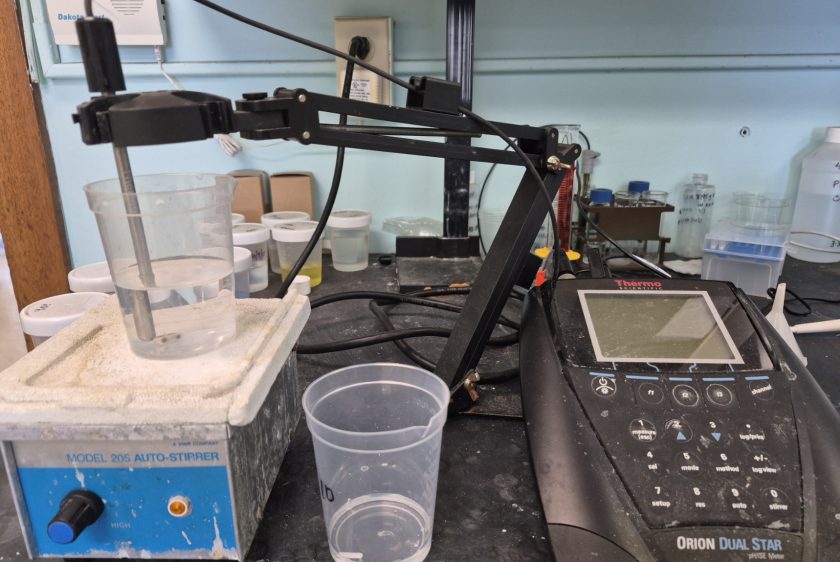
Controlled Exposure: The material is immersed in the chemical at a specific temperature (e.g., 23°C, 50°C, or 70°C) for a set duration (typically 7 days to 30 days).
Mechanical Testing: We perform “Post-Exposure” tensile or hardness testing to see if the chemical has “weakened” the molecular structure.
Fluid Analysis: We analyze the fluid itself using ICP-OES and GC-MS to see what the material has “given up” (leached) into the chemical.
Microscopic Inspection: We use high-resolution microscopy to look for “Micro-Crazing” or surface pitting that precedes particulate shedding.
5. Case Study: The "Mystery Black Specks" in a Bioreactor
A pharmaceutical client was finding 10-micron “black specks” in their final product. They had replaced their filters three times, but the specks kept appearing.
The Sterling Analytical Investigation:
Particulate Analysis: We captured the specks and performed SEM-EDS. The particles were identified as a “Fluorocarbon-based elastomer” (Viton).
Chemical Compatibility Audit: We reviewed the client’s new “CIP” (Clean-In-Place) protocol. They had recently switched to a more aggressive alkaline cleaner.
The Test: We exposed the client’s Viton gaskets to the new cleaner at the operating temperature (80°C). Within 48 hours, the gaskets began to “slough off” microscopic layers of material.
The new cleaning agent was chemically attacking the cross-linking of the Viton polymer, causing it to shed particulates during every cleaning cycle.
The Result: The client switched to an EPDM gasket that was validated via ASTM D543 to be compatible with the new cleaner. The “black specks” disappeared immediately, saving a $500,000 batch of product.
6. Industry Applications
Semiconductor Manufacturing
In “Fab” environments, even the vapors from an incompatible lubricant can “poison” a silicon wafer. We test all cleanroom materials (wipes, gloves, tubing) for chemical compatibility with process gases to prevent Molecular Contamination.
Medical Device Packaging
We ensure that the “Adhesives” used in medical packaging are compatible with the “Sterilization Chemicals” (like Ethylene Oxide). If the adhesive breaks down, it can create residues that contaminate the sterile device.
Food & Beverage
We validate that “Food-Grade” hoses and seals do not leach “Phthalates” or “Plasticizers” when exposed to acidic juices or high-fat dairy products.
Submission Guidelines for Compatibility Testing
To get the most accurate “Cleanliness-Focused” compatibility data:
Material Samples: Provide at least 5-10 “Coupons” of the material (typically 1″ x 3″ strips or actual O-rings).
The Chemical: Provide at least 1 Liter of the process fluid or cleaning agent.
The “Blank”: If possible, provide a sample of the fluid before it has touched any materials.
Operating Conditions: Specify the maximum temperature and the “Duty Cycle” (e.g., “Continuous immersion” vs. “10-minute cleaning wash once per day”).
Ensure Your Materials Stay Clean and Compatible
Chemical incompatibility is often the hidden cause of particulate contamination, leaching, and premature material failure. Sterling Analytical provides ASTM D543 and ISO-based testing to verify that your plastics, elastomers, and composites will perform safely under real-world conditions. Our data helps prevent costly downtime, product recalls, and regulatory compliance issues.
Take the next step with our expert laboratory services:
Frequently Asked Questions
"Resistance" usually implies the material won't melt or fall apart. "Compatibility" is a higher standard—it means the material won't melt, and it won't leach, shed, swell, or discolor the fluid it is in contact with.
If your system uses multiple chemicals (e.g., a cleaner followed by a rinse followed by a lubricant), we can perform "Sequential Exposure" testing to see if the combination of chemicals causes a failure that a single chemical would not.
By using the Arrhenius Equation and increasing the testing temperature, we can often correlate a 7-day high-temperature test to 1-2 years of room-temperature service.
Yellowing is usually a sign of Antioxidant Depletion or the oxidation of specific additives within the polymer matrix. While the plastic may still be structurally sound in the short term, the yellowing indicates that the material's protective chemistry is being "consumed" by the chemical environment. Once these antioxidants are exhausted, the polymer backbone itself will begin to degrade, leading to surface micro-cracking, loss of mechanical strength, and eventually, the shedding of microscopic plastic particulates into your system.
Volume swell occurs when a fluid is absorbed into an elastomer (like an O-ring). While a 5% swell might be mechanically acceptable for a seal, it is a major "Cleanliness" concern. As the material swells, it opens up the polymer's "pores," allowing it to trap microscopic particulates and bacteria that cannot be removed by standard cleaning cycles. Furthermore, when the system dries or the chemical is removed, the material "shrinks" back, often trapping these contaminants or "spitting" out degraded polymer fragments.
Yes. This is known as Component-Level Incompatibility. A material might be chemically resistant to a fluid, but the combination of the material, the fluid, and a specific temperature or pressure can trigger a failure. For example, a plastic might be compatible with a lubricant at 25°C but undergo "Environmental Stress Cracking" (ESC) at 60°C. This is why we always recommend testing under actual "End-Use" conditions.
Quick Contact
If you have any questions or need help, feel free to contact with our team.
Send Us Email:
Call Us Today: