Landline Phone:
(413) 214-6541
Location:
15 Agawam Ave West Springfield, MA 01089
Mon - Fri:
8.00am - 4.00pm
Sludge BTU & Energy Content Analysis Services
Related Posts
Sterling Analytical provides high-precision Sludge BTU (British Thermal Unit) and Energy Content Analysis, transforming wastewater residuals into quantifiable fuel data. As the global energy landscape shifts toward “Resource Recovery,” municipal and industrial facilities are increasingly viewing sludge not as a disposal liability, but as a high-energy feedstock.
Whether you are evaluating the feasibility of a Waste-to-Energy (WTE) plant, optimizing a municipal incinerator, or producing Refuse-Derived Fuel (RDF), our laboratory provides the definitive calorific values required for engineering design and operational efficiency. Using oxygen bomb calorimetry and ASTM-certified methodologies, we determine the Higher Heating Value (HHV) and Lower Heating Value (LHV) of your biosolids, ensuring your thermal processes are both economically viable and environmentally compliant.
If you are searching for a BTU testing laboratory near me to calculate the “autogenous” (self-sustaining) combustion point of your sludge or to validate the energy density of industrial byproducts, Sterling Analytical delivers the technical depth and NIST-traceable precision necessary for modern energy management.
The Importance of Energy Profiling in Biosolids
The energy content of sludge is primarily derived from the organic compounds—fats, proteins, and carbohydrates—captured during the wastewater treatment process. However, this energy is often “locked” behind high moisture and ash content. Professional BTU analysis is critical for:
1. Determining Autogenous Combustion
In incineration, the “holy grail” is autogenous combustion—where the sludge contains enough internal energy to burn without the need for supplemental natural gas or fuel oil. Sterling Analytical’s BTU data allows engineers to calculate the exact moisture-to-solids ratio required to reach this “break-even” point, potentially saving facilities millions in annual fuel costs.
2. Waste-to-Energy (WTE) Feasibility
For facilities exploring gasification, pyrolysis, or co-firing in cement kilns, the BTU/lb (or MJ/kg) value is the primary metric for Return on Investment (ROI). Our analysis helps project developers determine the “energy ROI” of dewatering and drying technologies.
3. Greenhouse Gas (GHG) Offsets
Energy derived from sewage sludge is considered “biogenic.” By quantifying the BTU content, facilities can calculate how much fossil fuel energy they are displacing, which is essential for securing carbon credits and meeting corporate sustainability goals.
Our Core Energy Analytical Capabilities
Sterling Analytical utilizes a combination of wet chemistry, combustion analysis, and spectroscopy to provide a complete chemical fingerprint of sludge samples.
1. Higher Heating Value (HHV / Gross Calorific Value)
The HHV is the total energy released during the complete combustion of a dry sample, including the energy released by the condensation of water vapor produced during the burn.
Engineering Use: This is the standard “benchmark” value used to compare different fuel sources and is the starting point for all boiler efficiency calculations.
2. Lower Heating Value (LHV / Net Calorific Value)
The LHV represents the “real-world” energy available for recovery. It subtracts the energy required to vaporize the water formed during combustion.
Engineering Use: Because industrial incinerators do not typically condense exhaust gases, the LHV is the most accurate reflection of the usable heat available to produce steam or electricity.
3. Net Heat of Combustion (As-Received Basis)
Sludge is rarely 100% dry. We provide calculations that factor in your specific “as-received” moisture content. This reveals the “net energy” of the wet cake, often showing how much energy is “stolen” by the need to evaporate the remaining water in the sludge.
4. Ash-Free BTU (MAI - Moisture Ash Free)
By calculating the BTU value on a Moisture-Ash-Free (MAF) basis, we isolate the energy potential of the pure organic fraction. This allows for a direct comparison between different treatment processes (e.g., raw vs. anaerobically digested sludge) regardless of how much grit or chemical coagulant is present.
The Science of Oxygen Bomb Calorimetry
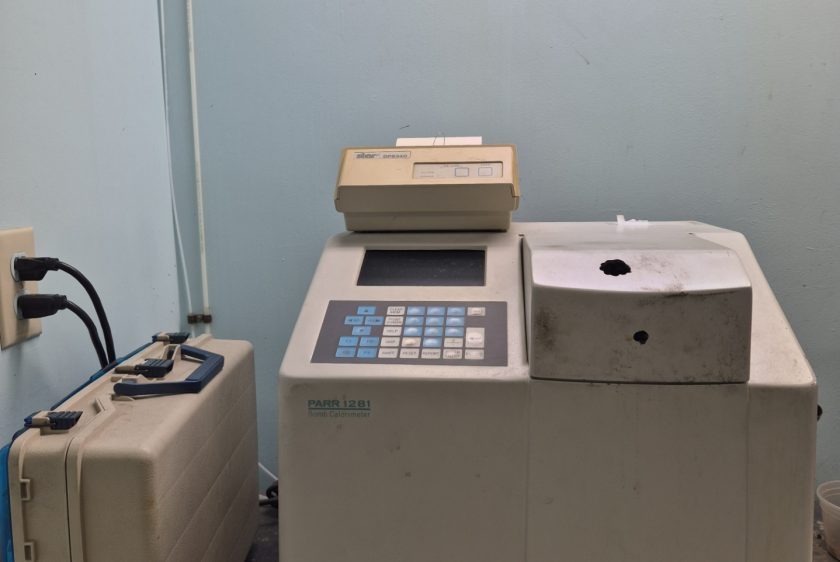
At Sterling Analytical, we utilize the ASTM D5865 and ASTM D240 standards, employing a high-precision Oxygen Bomb Calorimeter.
1. The Combustion Process
A finely ground, dried sample of sludge (typically 1 gram) is placed in a stainless-steel “bomb” vessel. The vessel is pressurized with pure oxygen to approximately 30 atmospheres (450 psi). The bomb is submerged in a highly insulated water bath, and the sample is ignited via an electric fuse wire.
2. Isoperibol Temperature Monitoring
As the sample burns, it releases heat into the surrounding water. Our sensors track the temperature rise with a resolution of 0.0001°C. Because the system is “isoperibol” (constant environment temperature), we can calculate the energy release with extreme accuracy, accounting for even the tiny amount of heat generated by the fuse wire itself.
3. Corrections for Acid Formation
During combustion, small amounts of nitric and sulfuric acids are formed. These chemical reactions release a small amount of “extra” heat that isn’t derived from the fuel itself. Sterling Analytical performs “acid titrations” on the bomb washings to subtract this heat, ensuring the reported BTU value is purely from the sludge organic matter.
Engineering Impact: Energy Density and Operational Costs
A. The "Digestion Dilemma"
Anaerobic digestion (AD) is excellent for producing methane gas, but it “consumes” the volatile solids that provide BTU value to the sludge cake.
Impact: Facilities that both digest and incinerate must find a balance. Our testing helps you determine if the energy gained in biogas is worth the energy lost in the final incineration of the “spent” digestate.
B. Impact of Chemical Conditioning
The use of Ferric Chloride or Alum for phosphorus removal increases the Ash Content of the sludge.
Impact: Ash has zero BTU value and acts as a “heat sink,” absorbing energy without giving any back. Sterling Analytical’s BTU vs. Ash analysis helps engineers evaluate the thermal cost of their chemical phosphorus removal strategies.
C. Dewatering Efficiency
Every 1% increase in “cake dryness” significantly increases the net energy available for combustion. Our lab provides the data used to justify the purchase of high-efficiency belt presses or centrifuges by showing the direct increase in “As-Received BTU.”
Compliance and Quality Assurance
Our testing protocols are designed to meet:
ASTM D5865: Standard Test Method for Gross Calorific Value of Coal and Coke (adapted for biosolids).
ASTM D240: Standard Test Method for Heat of Combustion of Liquid Hydrocarbon Fuels (for liquid sludge/slurries).
EPA 40 CFR Part 503: Supporting the thermal processing requirements for sewage sludge.
NIST Traceability: Our calorimeters are standardized using certified Benzoic Acid pellets from the National Institute of Standards and Technology.
Problems Identified
Through BTU and energy analysis, we frequently identify
Negative Net Energy: Samples where the moisture content is so high that it requires more energy to dry the sludge than the sludge itself contains.
Ash Overloading: High concentrations of inert grit or treatment chemicals that are “smothering” the combustion process.
Process Inefficiency: Significant drops in BTU value between raw and digested sludge that indicate a digester might be “over-processing” the material at the expense of downstream fuel value.
Fuel Variability: Seasonal swings in energy content caused by industrial “slug loads” (e.g., fats/oils from food processors) that can cause incinerator temperature spikes.
Who Needs This Testing?
WTE Plant Engineers: Modeling steam production and turbine output.
Municipal WWTP Superintendents: Optimizing incinerator fuel costs and air permit compliance.
Cement Kiln Operators: Evaluating sludge as a “supplemental fuel” to replace coal.
Drying Equipment Manufacturers: Validating the performance of thermal dryers.
Sustainability Officers: Documenting biogenic energy production for ESG (Environmental, Social, and Governance) reporting.
How to Submit a Sample
Sample Volume: Provide at least 500g of dewatered cake or 1 Liter of liquid sludge.
Container: Use wide-mouth HDPE or glass jars. Ensure the seal is tight to prevent moisture loss, which would skew the “As-Received” calculation.
Preservation: Keep samples at 4°C during transport. Biological activity can “consume” the organic energy in the sample if it is allowed to sit at room temperature.
Homogenization: Sludge is non-homogenous. We recommend taking a 24-hour composite sample to ensure the BTU value represents the true average of your facility’s output.
Maximize Energy Insights from Your Sludge & Biosolids
Unlock the true fuel potential of your residuals with Sterling Analytical’s high-precision BTU and energy content testing. Our laboratory provides NIST-traceable calorific data to optimize Waste-to-Energy operations, incineration efficiency, and thermal process design—helping facilities save costs, comply with regulations, and measure renewable energy contributions.
Get started with expert lab support today:
Frequently Asked Questions
Yes. Fats, Oils, and Grease (FOG) have extremely high energy density, often exceeding 12,000 to 15,000 BTU/lb on a dry basis. Testing FOG separately helps facilities determine the potential energy "boost" they can get by co-digesting or co-firing these high-energy streams compared to standard sewage sludge.
Higher Heating Value (HHV) is the total heat released, including the energy from condensing the water vapor produced during combustion. Lower Heating Value (LHV) subtracts that condensation energy. Since most industrial incinerators do not condense their exhaust, the LHV is the "real-world" energy available to your system.
Ash is chemically inert; it does not burn. Therefore, every pound of ash in your sludge is a pound of material that consumes heat (to reach furnace temperature) without contributing any energy back. If your ash content is high (e.g., >30%), your BTU/lb will drop significantly, even if the organic portion is high-quality.
Benzoic Acid is a "Primary Standard" with a very stable and precisely known heat of combustion (26.454 MJ/kg). By burning a known mass of Benzoic Acid, we "calibrate" the calorimeter, ensuring that the temperature rise we measure in your sludge sample is converted into an accurate BTU value.
Standard turnaround is typically 5–7 business days. Because the sample must be completely dried and homogenized before it can be placed in the oxygen bomb, the drying process is the most time-consuming step.
Quick Contact
If you have any questions or need help, feel free to contact with our team.
Send Us Email:
Call Us Today: