Landline Phone:
(413) 214-6541
Location:
15 Agawam Ave West Springfield, MA 01089
Mon - Fri:
8.00am - 4.00pm
Boiler Water Testing & Steam Chemistry Services
Related Posts
In the field of Industrial Water Analysis, boiler systems represent the highest-stakes environment for chemical management. A boiler is essentially a high-temperature concentrator; as water is converted to steam, the dissolved solids left behind reach concentrations that can lead to rapid metal fatigue, tube rupture, and catastrophic explosive failure.
Sterling Analytical provides the rigorous testing required to manage these extreme conditions. Unlike Cooling Tower Water Testing, which deals with open evaporation at lower temperatures, boiler chemistry must be managed within a closed, high-pressure loop where even trace amounts of oxygen or hardness can be fatal to the system. From low-pressure firetube boilers to high-pressure water-tube utility boilers, our laboratory provides the NIST-traceable data needed to maintain ASME (American Society of Mechanical Engineers) and ABMA (American Boiler Manufacturers Association) water quality standards.
The Physics of Failure: Why Boiler Chemistry is Non-Negotiable
Boiler failure is rarely a sudden event; it is the result of long-term chemical imbalances that manifest in three primary ways:
1. Waterside Scaling (The Thermal Insulator)
When “Hardness” ions (Calcium and Magnesium) enter the boiler via the Feedwater, they precipitate onto the hottest surfaces—the tubes.
The Energy Penalty: Scale is an incredibly effective insulator. Just 1/16th of an inch of scale can increase fuel consumption by 12-15% because the burner must work harder to push heat through the scale and into the water.
The Safety Risk: Because scale prevents the water from cooling the metal tubes, the metal can reach its “softening point.” This leads to a “bag” (a bulge in the metal) or a catastrophic rupture.
Our Solution: We monitor for total hardness and compare it against your pre-treatment logs to ensure your water softener or RO system is performing correctly.
2. Oxygen Pitting & Corrosion
At high temperatures, dissolved oxygen becomes incredibly aggressive. It causes “pitting”—a localized form of corrosion that can “drill” a hole through a thick steel tube in a matter of weeks.
The Chemical Shield: Operators use “Oxygen Scavengers” like Sodium Sulfite or Hydrazine to chemically remove oxygen that the deaerator missed.
Our Analysis: We measure the “Sulfite Residual” to ensure you have enough chemical “shield” to protect the metal, but not so much that you are wasting money or unnecessarily increasing your Total Dissolved Solids (TDS).
3. Caustic Embrittlement & Foaming
If the pH or alkalinity is too high, the water can become “caustic,” leading to a phenomenon where the metal becomes brittle and cracks along the grain boundaries. High alkalinity also causes “foaming” at the water’s surface, leading to Carryover—where liquid water enters the steam lines, damaging downstream turbines, valves, and heat exchangers.
Critical Parameters in Boiler Water Analysis
Sterling Analytical provides a comprehensive suite of tests designed to balance the “Internal Treatment” of the boiler:
P-Alkalinity & M-Alkalinity: These measurements allow us to calculate the exact forms of alkalinity (Hydroxide, Carbonate, Bicarbonate) present. This is critical for preventing both scale and corrosion.
Phosphate Residual: Many boilers use a “Phosphate Program” to keep any stray hardness in a soft, fluid sludge state that can be removed via “Blowdown.” We measure orthophosphate to ensure your dosing is accurate.
Conductivity / TDS: This is the primary metric for controlling “Blowdown.” High TDS leads to foaming and carryover; low TDS indicates you are wasting fuel by dumping hot, treated water down the drain.
Silica ($SiO_2$): In high-pressure systems (>600 psi), silica can actually “vaporize” and carry over with the steam, depositing onto turbine blades and causing permanent mechanical damage.
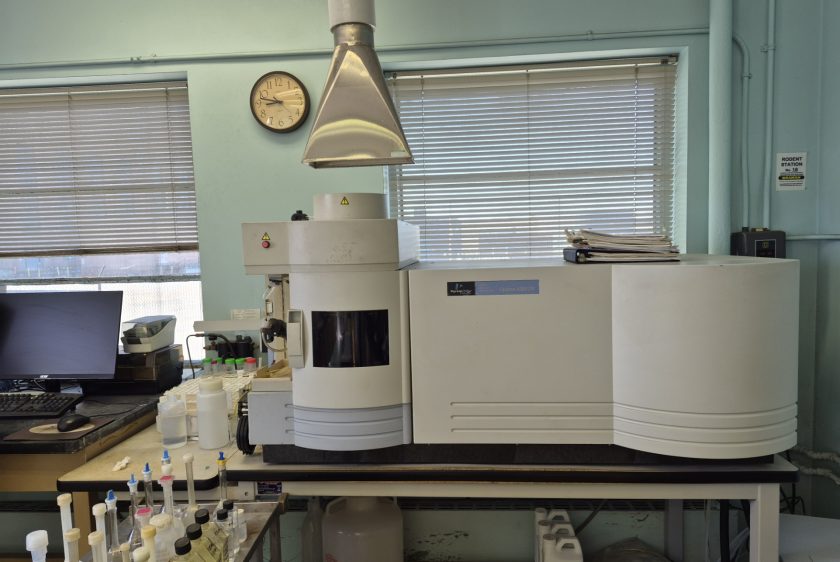
Iron & Copper: We utilize Heavy Metals Testing (ICP-OES) to monitor for these metals. A spike in Iron indicates active boiler corrosion, while Copper indicates corrosion in the condensate return system.
The Condensate Return Loop
A common mistake in Industrial Water Analysis is ignoring the “Return” side of the system. Condensate is essentially distilled water, which is naturally “hungry” and corrosive.
Carbonic Acid Attack
When steam condenses, it can absorb Carbon Dioxide ($CO_2$), forming Carbonic Acid. This acid eats away at the return piping, creating “grooving” corrosion.
The Chemistry: $CO_2 + H_2O \rightarrow H_2CO_3$ (Carbonic Acid).
The Solution: Neutralizing or Filming Amines are added to the steam to protect the pipes.
Our Analysis: We test the pH and Iron levels of the condensate return. If the pH is below 8.0, your return lines are at risk of failure. This is a critical step that differentiates a “basic” test from a “professional” boiler analysis.
ASME Guidelines
Sterling Analytical benchmarks your results against industry standards. While every plant is different, typical targets for a 0-300 psi firetube boiler include:
Hardness: 0 ppm (Target)
Total Alkalinity: < 700 ppm
Sulfite Residual: 30–60 ppm
Phosphate Residual: 20–40 ppm
Silica: < 150 ppm
For high-pressure utility boilers (>1000 psi), these limits become exponentially tighter, often requiring Lithium Brine Testing levels of precision for trace contaminants.
ROI and Fuel Savings
Our data is used by plant engineers to drive three key outcomes:
Fuel Efficiency: By maintaining a scale-free environment, we ensure the maximum “Heat Transfer Coefficient,” directly reducing natural gas or fuel oil consumption.
Water Conservation: By optimizing the “Cycles of Concentration,” we reduce the amount of water lost to blowdown.
Asset Life Extension: A well-treated boiler can last 50+ years. A poorly treated one can be “junked” in 5 years. Our testing provides the “insurance policy” for your capital equipment.
Problems Identified
Softener Breakthrough: Detecting hardness in the boiler that suggests the ion-exchange resin in your Feedwater system has failed.
Oxygen Ingress: Identifying low sulfite levels that suggest a leak in the deaerator (DA) tank or a failing chemical pump
Steam Contamination: Detecting high conductivity in the condensate, which suggests a “process leak” (e.g., oil or chemicals) is entering the steam loop.
Carryover Events: Identifying high Silica or Sodium in the steam, protecting downstream turbines from catastrophic “slugs” of water.
How to Submit a Sample
Safety First: Boiler water is under high pressure and temperature. Always use a Sample Cooler to bring the water temperature below 100°F (38°C) before collecting.
Sample Location: Samples should be taken from the “Continuous Blowdown” line to ensure you are getting a representative “bulk water” sample.
Container: 500mL to 1 Liter HDPE bottle. Ensure the bottle is rinsed three times with the sample water before the final fill.
Hold Times: Sulfite and pH should be tested immediately in the field if possible, but our lab can provide “stabilized” results if the sample is shipped overnight and kept cool.
Ensure Optimal Performance with Cooling & Boiler Water Testing
Sterling Analytical provides advanced testing and analysis of cooling and boiler water systems, delivering the critical data needed to maintain efficiency, prevent corrosion, and control scaling and fouling.
Our NIST-traceable results help facility managers, plant operators, and maintenance teams optimize system performance, reduce chemical and energy costs, and ensure compliance with industry standards and safety regulations.
Take the next step with our expert laboratory services:
Frequently Asked Questions
This usually indicates "Iron Oxide" (rust). It means your oxygen scavenger is failing or your condensate return system is corroding and "pumping" iron back into the boiler.
Blowdown is the intentional draining of a small amount of boiler water to remove concentrated solids. We use conductivity to tell you if you are blowing down too much (wasting heat) or too little (risking scale).
Generally, no. Storm water contains high levels of organics and suspended solids that would cause immediate foaming and scaling. However, highly treated "reclaimed" water can be used if the Feedwater Chemistry is strictly managed.
Both systems involve evaporation and concentration. However, boilers operate at much higher temperatures and pressures, making the chemistry far more volatile and the consequences of failure far more dangerous.
Quick Contact
If you have any questions or need help, feel free to contact with our team.
Send Us Email:
Call Us Today: