Landline Phone:
(413) 214-6541
Location:
15 Agawam Ave West Springfield, MA 01089
Mon - Fri:
8.00am - 4.00pm
Alkalinity, Acidity, Chloride, and Hardness Testing Services
Related Posts
Sterling Analytical provides specialized titrimetric and ion-specific analysis for the four most critical parameters in water chemistry: Alkalinity, Acidity, Chloride, and Hardness. These measurements are the “DNA” of water stability. They determine whether water will be “aggressive” (corroding pipes and leaching metals) or “scaling” (clogging heat exchangers and reducing flow). Our laboratory supports municipal water treatment plants, industrial facility managers, and environmental engineers with high-precision data used to balance chemical equilibrium and protect multi-million dollar infrastructure.
Using certified Standard Methods (SM) and ASTM protocols, our wet chemistry department performs rigorous volumetric titrations and colorimetric analyses. If you are searching for a water chemistry laboratory near me to troubleshoot scaling in a cooling tower or to monitor chloride levels in a coastal aquifer, Sterling Analytical offers the defensible data and technical insight required for proactive asset management.
The interaction between these four parameters defines the “Langelier Saturation Index” (LSI) and the “Ryznar Stability Index” (RSI)—the industry-standard calculations used to predict how water will behave when it comes into contact with metal and concrete surfaces. Without accurate lab data for these variables, chemical treatment programs are based on guesswork, leading to either wasted chemicals or catastrophic equipment failure.
Our Core Analytical Capabilities
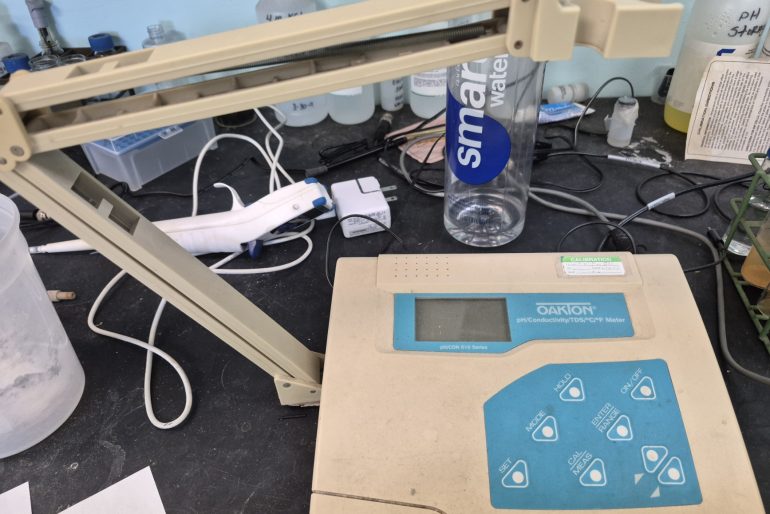
Sterling Analytical utilizes automated titrators and standardized chemical reagents to ensure the highest level of repeatability and accuracy for these fundamental water quality tests.
1. Alkalinity Analysis (SM 2320B)
Alkalinity is the measure of water’s “buffering capacity“—its ability to neutralize acids without a significant change in pH. It is primarily composed of bicarbonate, carbonate, and hydroxide ions.
Total Alkalinity: Measured by titration to a pH of 4.5. This is the primary metric for drinking water stability and wastewater nitrification processes.
Phenolphthalein Alkalinity (P-Alkalinity): Measured by titration to pH 8.3, identifying the presence of carbonates and hydroxides, critical for high-pressure boiler water management.Bicarbonate, Carbonate, and Hydroxide Fractions: We provide a detailed breakdown of these components, allowing engineers to fine-tune lime-softening and pH-adjustment programs.
2. Acidity Analysis (SM 2310B)
While pH tells you how acidic a solution is, Acidity tells you how much base is required to neutralize it.
Mineral Acidity: Caused by strong mineral acids (sulfuric, hydrochloric), often found in industrial waste or acid mine drainage.
CO2 Acidity: Caused by dissolved carbon dioxide, which forms weak carbonic acid. This is a common cause of corrosion in steam condensate return lines.
Total Acidity: The sum of all titratable acidity, used to design neutralization systems for industrial discharge.
3. Chloride Content (SM 4500-Cl- B / ASTM D512)
Chloride is a highly aggressive ion that accelerates the corrosion of almost all metals by penetrating protective oxide layers.
Argentometric Titration: The standard method for determining chloride in relatively clean water.
Potentiometric Titration: Used for colored or turbid samples where a visual color change cannot be detected.
Corrosivity Indicators: High chloride levels are a primary indicator of saltwater intrusion in coastal wells and road-salt contamination in surface waters.
4. Water Hardness (SM 2340C / ASTM D1126)
Hardness is the concentration of multivalent cations, primarily Calcium (Ca2+) and Magnesium (Mg2+).
Total Hardness by EDTA Titration: The industry standard for determining the “grains per gallon” or “mg/L as CaCO3” of hardness.
Calcium vs. Magnesium Hardness: We separate these two components, as calcium is the primary driver of carbonate scale, while magnesium can form silicate scales that are nearly impossible to remove.
Temporary vs. Permanent Hardness: Distinguishing between hardness that can be removed by boiling (bicarbonates) and hardness that remains (sulfates/chlorides).
The Engineering Impact of the "Big Four"
1. Lead and Copper Rule (LCR) Compliance
For municipal water providers, Alkalinity and pH are the primary tools for “Corrosion Control Treatment” (CCT). By maintaining high alkalinity, the water forms a protective mineral scale inside lead and copper pipes, preventing these toxic metals from leaching into the drinking water. Our lab provides the precise alkalinity data needed to meet EPA requirements.
2. Boiler and Cooling Tower Efficiency
In heat transfer equipment, “Hardness” is the enemy. When hard water is heated, calcium carbonate precipitates out of solution, forming a rock-hard scale on boiler tubes. Just 1/16th of an inch of scale can reduce heat transfer efficiency by 15%, leading to massive energy waste and potential tube rupture. Our testing monitors the effectiveness of softeners and ion-exchange units.
3. The Chloride-to-Sulfate Mass Ratio (CSMR)
Recent research has shown that the ratio of Chloride to Sulfate is a key predictor of galvanic corrosion in plumbing systems. If the CSMR is high (>0.5), the risk of lead leaching increases significantly. Sterling Analytical provides the paired ion analysis needed to calculate this critical ratio.
4. Wastewater Nitrification
In biological wastewater treatment, the process of “nitrification” (converting ammonia to nitrate) consumes alkalinity. For every 1 mg of ammonia oxidized, approximately 7.14 mg of alkalinity is destroyed. If the alkalinity drops too low, the pH will crash, killing the beneficial bacteria. Our lab monitors this “alkalinity reserve” to prevent plant upsets.
Compliance and Regulatory Support
Our testing protocols are designed to meet the requirements of:
EPA Safe Drinking Water Act (SDWA): Monitoring secondary contaminants and corrosion control parameters.
NPDES Permits: Ensuring industrial effluent does not exceed acidity or chloride limits that could harm local ecosystems.
ASME Boiler Water Guidelines: Providing the high-resolution data required to maintain water chemistry within the strict limits of high-pressure steam systems.
Cooling Technology Institute (CTI): Supporting best practices for open and closed-loop cooling water management.
Problems Identified
Through our titrimetric analysis, we frequently identify:
Aggressive Water: Low alkalinity and high acidity leading to “pinhole leaks” in copper plumbing.
Scale Accumulation: High hardness levels that exceed the capacity of on-site water softeners.
Saltwater Intrusion: Spikes in chloride levels in groundwater wells near coastal areas.
Condensate Corrosion: High acidity in steam return lines indicating a failure in the deaerator or chemical treatment.
Environmental Consultants: Assessing the impact of sediment runoff in rivers and streams.
Nitrification Failure: Depleted alkalinity in wastewater aeration basins leading to pH instability.
Who Needs This Testing?
Municipal Water Utilities: Managing corrosion control and lead/copper compliance.
Power Plants & Refineries: Protecting high-pressure boilers and heat exchangers.
HVAC Contractors: Testing chilled water and boiler loops for seasonal maintenance.
Industrial Laundries: Monitoring hardness to optimize detergent usage and prevent fabric graying.
Environmental Consultants: Assessing the impact of road salt or industrial spills on local watersheds.
Food & Beverage Manufacturers: Ensuring water quality does not affect product taste or equipment longevity.
How to Submit a Sample
Sample Volume: Provide at least 500mL of sample in a clean HDPE bottle
No Headspace: For Alkalinity and Acidity, fill the bottle to the brim to prevent CO2 exchange with the atmosphere.
Preservation: Do NOT acid-preserve samples for these tests, as it will destroy the alkalinity and acidity values.
Temperature: Keep samples at 4°C during transport to minimize chemical shifts.
Hold Times: Alkalinity and Acidity have a short hold time of 14 days, but for the most accurate results, analysis should occur within 48-72 hours.
Schedule Alkalinity, Acidity, Chloride, and Hardness Testing Today
Reliable water and soil quality analysis starts with accurate chemical balance testing. Without proper evaluation of alkalinity, acidity, chloride levels, and hardness, hidden imbalances can lead to corrosion, scaling, and reduced system performance.
Sterling Analytical provides comprehensive laboratory-based testing to measure key chemical parameters, assess water and soil quality, and support environmental monitoring and regulatory compliance requirements.
Frequently Asked Questions
No. TDS measures all dissolved solids (including sodium and chloride). Hardness specifically measures multivalent cations like Calcium and Magnesium. You can have high TDS water that is actually "soft" (e.g., softened water high in sodium).
pH is an intensity factor (how "strong" the base is), while Alkalinity is a capacity factor (how "much" base is there). Water can have a high pH but very little "staying power," meaning a small amount of acid will cause the pH to drop rapidly.
Chloride is very difficult to remove and typically requires Reverse Osmosis (RO) or deionization. This is why monitoring and preventing chloride contamination is so critical.
For high-pressure systems, daily on-site testing is recommended, with weekly or monthly "check-ups" by a certified third-party lab like Sterling Analytical to verify the accuracy of on-site kits.
Quick Contact
If you have any questions or need help, feel free to contact with our team.
Send Us Email:
Call Us Today: