Landline Phone:
(413) 214-6541
Location:
15 Agawam Ave West Springfield, MA 01089
Mon - Fri:
8.00am - 4.00pm
Engine & Motor Oil Analysis: The "Blood Test" for Your Machinery
In the world of heavy industry, marine transport, and power generation, an engine is a massive capital investment. Whether it is a high-speed diesel in a trucking fleet, a natural gas engine in a peaking plant, or a massive low-speed marine engine, the oil circulating through its veins carries a detailed history of its health.
Engine & Motor Oil Analysis is the process of extracting that history. At Sterling Analytical, we treat oil analysis as a diagnostic “blood test.” By analyzing the microscopic particles and chemical changes within the lubricant, we can identify a failing bearing, a leaking head gasket, or a clogged air filter weeks before a physical symptom appears.
While a standard UOA (Used Oil Analysis) provides a general overview, our specialized engine oil suite is designed to detect the specific stressors of internal combustion: soot, fuel dilution, and acid neutralization.
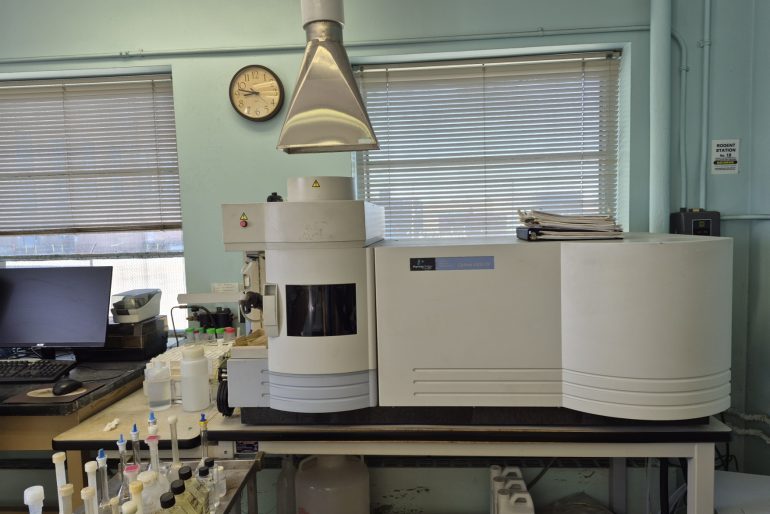
1. Elemental Wear Metal Analysis (ICP-OES)
The core of any engine oil test is Spectrometric Wear Analysis. Using Inductively Coupled Plasma (ICP), we measure the concentration of microscopic metal particles in parts-per-million (ppm). These metals are the “fingerprints” of specific engine components.
Iron (Fe): The most common wear metal. High iron usually points to cylinder liner wear, crankshaft journals, or valve train components.
Copper (Cu): Found in thrust washers, bushings, and oil coolers. A sudden spike in copper often indicates a cooling system problem or bushing fatigue.
Lead (Pb): The primary indicator of bearing wear. If lead levels rise alongside copper, it suggests the bearing overlay is being stripped away.
Aluminum (Al): Typically originates from pistons or engine blocks. High aluminum combined with high silicon (dirt) suggests “dusting,” where abrasive particles are scouring the piston skirts.
Chromium (Cr): Found in piston rings and some high-strength bearings. High chromium is a sign of ring-to-liner friction.
Tin (Sn): Often alloyed with lead in bearings; its presence confirms bearing shell degradation.
By tracking these metals over time (Trend Analysis), Sterling Analytical can tell you not just that your engine is wearing, but which part is failing.
2. Viscosity: The Most Critical Physical Property
Viscosity is the measure of an oil’s resistance to flow. It is the most important characteristic of a lubricant because it determines the thickness of the oil film that prevents metal-to-metal contact.
At Sterling Analytical, we measure Kinematic Viscosity at $40^\circ C$ and $100^\circ C$ (ASTM D445).
Why Viscosity Increases: Oil “thickens” due to oxidation, excessive soot loading (common in diesels), or the use of the wrong top-off oil. High viscosity leads to poor flow during startup and increased internal friction.
Why Viscosity Decreases: Oil “thins” primarily due to Fuel Dilution (leaking injectors) or shear thinning of the Viscosity Index (VI) improvers. Low viscosity is dangerous because the oil film becomes too thin to protect the bearings, leading to rapid wear.
3. Chemical Health: TBN and TAN
The internal combustion process creates acidic byproducts. If these acids are not neutralized, they will corrode engine internals.
Total Base Number (TBN) - ASTM D2896/D4739
Engine oils are formulated with alkaline additives to neutralize acids. TBN measures this “reserve alkalinity.”
The Rule of Thumb: When the TBN drops to 50% of its original value (or falls below 2.0), the oil has lost its ability to protect the engine from acid-induced corrosion, and an oil change is mandatory.
Total Acid Number (TAN) - ASTM D664
While TBN is the focus for diesel and gasoline engines, TAN is critical for natural gas engines. It measures the concentration of acidic compounds. A rising TAN indicates oil oxidation and the potential for varnish and sludge formation.
4. Contamination: The Engine Killers
An engine oil analysis must identify external contaminants that compromise the lubricant’s integrity.
Soot (Infrared Analysis): A byproduct of incomplete combustion, especially in diesel engines. High soot levels increase viscosity and act as an abrasive. If soot exceeds 3%, the oil’s dispersant additives can no longer keep the particles in suspension, leading to “sludge.”
Fuel Dilution (Gas Chromatography): Unburned fuel entering the crankcase. Even 2-4% fuel dilution can drop the viscosity of a 15W-40 oil down to a 30-weight or lower, stripping away the protective film on the crankshaft.
Coolant / Glycol (Sodium & Potassium): If we detect Sodium and Potassium in the ICP scan, it almost always indicates a leaking head gasket or oil cooler. Glycol reacts with oil to form “black sludge,” which can seize an engine in hours.
Silicon (Dirt/Dust): High silicon is the “smoking gun” for a bypass in the air intake system. Dirt is highly abrasive; it enters the cylinders and acts like liquid sandpaper on the rings and liners.
5. Oil Condition Monitoring (OCM) and Trend Analysis
At Sterling Analytical, we emphasize that a single oil analysis report is a “snapshot” in time. While a snapshot can identify an immediate crisis (like a massive coolant leak), the true power of engine oil analysis lies in Trend Analysis.
The Baseline
Every engine model has a unique “wear signature.” A high-speed diesel engine in a generator will wear differently than a natural gas engine in a compressor station. By establishing a baseline for your specific equipment, we can identify “statistical outliers.”
Rate of Change
If your Iron (Fe) levels have been steady at 20 ppm for three consecutive samples and suddenly jump to 60 ppm, that 300% increase is a major red flag—even if 60 ppm is still technically within the “acceptable” range for that engine type. This “Rate of Change” monitoring allows for Predictive Maintenance, where components are replaced during scheduled downtime rather than after a catastrophic “in-service” failure.
6. Extending Oil Drain Intervals (ODI) Safely
One of the primary economic drivers for professional engine oil analysis is the extension of oil drain intervals. In large fleets or power plants, changing oil based strictly on “hours” or “miles” is often wasteful.
The Science of Extension
We use a combination of UOA (Used Oil Analysis) data to determine if the oil is still chemically “fit for service.” To safely extend an interval, three conditions must be met:
- Additive Reserve: The TBN (Total Base Number) must remain above the critical threshold (typically >2.0 or 50% of new oil).
- Contamination Levels: Soot, fuel, and water must be within limits.
- Viscosity Stability: The oil must still be within its SAE grade (e.g., a 15W-40 must not have thinned to a 30-weight or thickened to a 50-weight).
By moving from a fixed schedule to a Condition-Based Monitoring (CBM) schedule, many of our clients safely double their oil life, reducing lubricant costs and environmental waste by 50%.
7. Advanced Diagnostics: Analytical Ferrography
When our standard ICP scan detects an “Abnormal” or “Critical” level of wear metals, we recommend Analytical Ferrography. While ICP measures particles smaller than 5-8 microns, ferrography allows us to look at larger wear debris (up to 100+ microns).
Our lab technicians use a bichromatic microscope to examine the shape, color, and size of the metal particles:
Rubbing Wear: Normal, small flakes indicating healthy operation.
Cutting Wear: Long, curly “shavings” that indicate a hard particle is gouging a soft metal surface (often caused by dirt ingestion).
Spheres: Microscopic balls of metal that indicate high-heat “welding” and tearing, common in bearing fatigue or cavitation.
Laminar Particles: Thin, flat flakes that indicate the “rolling out” of metal, typically from roller bearings or gear teeth.
8. Identifying Engine Failure Modes via Metal Ratios
Engine oil analysis is a detective’s game. We don’t just look at individual metals; we look at the ratios between them to identify the root cause of a problem.
The “Dusting” Signature (Al + Si): High Aluminum and high Silicon (Dirt) together almost always mean the air intake system is compromised. The dirt is acting as an abrasive on the aluminum pistons.
The “Coolant” Signature (Na + K + Cu): Sodium and Potassium (from coolant) combined with rising Copper (from the oil cooler) confirms a cooling system breach.
The “Bearing” Signature (Pb + Sn + Cu): Lead and Tin rising together indicate the bearing overlay is wearing. If Copper starts to rise afterward, the wear has reached the bronze backing of the bearing—failure is imminent.
The “Fuel” Signature (Low Viscosity + High Flash Point): If the viscosity drops and the flash point of the oil decreases, fuel is diluting the lubricant, likely from a cracked injector or a leaking fuel pump seal.
9. Sampling Best Practices: The Foundation of Accuracy
Sample While Hot: Always take the sample immediately after the engine has been running at operating temperature. This ensures that wear metals and contaminants are fully suspended in the oil and haven’t settled to the bottom of the sump.
The “Mid-Stream” Method: If sampling from a drain plug, let the first quart of oil flow out before catching the sample. This prevents “sump sludge” from contaminating the bottle.
The Vacuum Pump Method: Use a clean “Vampire” pump and new tubing to draw oil from the dipstick tube. Ensure the tube reaches the middle of the oil reservoir, not the very bottom.
Consistency is Key: Always sample from the same location using the same method to ensure your UOA (Used Oil Analysis) trends are accurate.
Integrated Oil Analysis Suite
Engine health is just one part of a comprehensive maintenance program. Sterling Analytical provides a full suite of lubricant testing:
UOA (Used Oil Analysis): The foundational test for all industrial lubricants, focusing on oxidation and general contamination.
Hydraulic Oil Analysis: Specialized testing for high-pressure systems, focusing on ISO Cleanliness and particle counts.
Transformer Oil Sample Analysis: Critical testing for electrical infrastructure, focusing on dielectric strength and dissolved gas analysis (DGA).
Frequently Asked Questions
For critical backup generators, we recommend semi-annual testing. For heavy-duty trucking or construction equipment, every 250–500 hours is standard. For marine or large-scale power engines, monthly testing is often required.
Soot is carbon. In small amounts, it is held in suspension by additives. In large amounts, it makes the oil abrasive and "thick," leading to increased wear on the valve train and plugged oil filters.
Yes. A spike in Silicon (Si) levels is the primary indicator of a "leaking" air intake system or a compromised air filter.
Rapid TBN depletion is usually caused by high-sulfur fuel or excessive "blow-by" (combustion gases leaking past the rings into the crankcase). Both conditions create high levels of acid that the oil must neutralize.
Quick Contact
If you have any questions or need help, feel free to contact with our team.
Send Us Email:
Call Us Today: