Landline Phone:
(413) 214-6541
Location:
15 Agawam Ave West Springfield, MA 01089
Mon - Fri:
8.00am - 4.00pm
Biomass Ash Chemistry Analysis: Predicting Boiler Behavior
Related Posts
In the operation of a biomass-fired power plant or industrial boiler, “Ash” is far more than just the inorganic residue left after combustion. It is a complex chemical cocktail of minerals and oxides that dictates the mechanical health, thermal efficiency, and overall uptime of the facility. While Biomass Moisture Analysis tells you how much fuel you need, and Biomass Heating Value Analysis tells you the energy potential, Ash Chemistry tells you whether your boiler will still be running next week.
At Sterling Analytical, our Biomass Ash Chemistry Analysis provides a deep-dive into the elemental makeup of your fuel’s inorganic fraction. By quantifying the concentrations of silica, alumina, iron, calcium, and—most critically—alkali metals like potassium and sodium, we help you predict and prevent the catastrophic formation of slag and fouling.
In the transition from coal to biomass, many operators are surprised to find that biomass ash behaves much more aggressively. Our laboratory data provides the “Early Warning System” needed to manage these volatile mineral profiles.
1. The Chemical Profile: The "Big Ten" Oxides
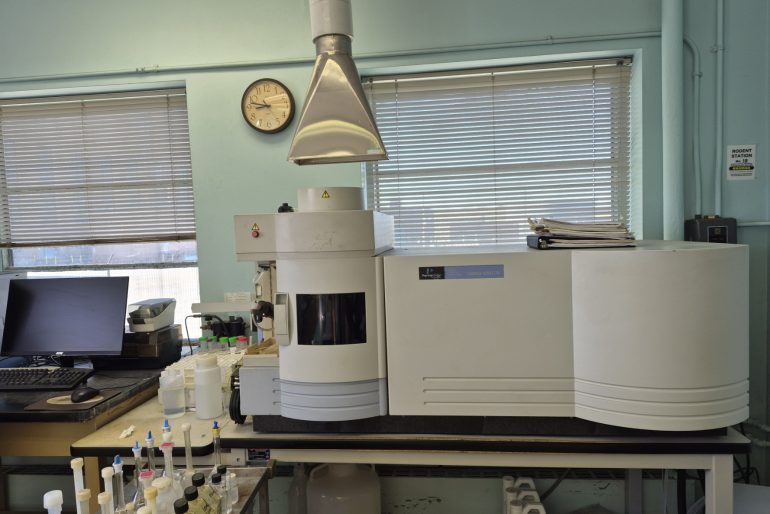
When we analyze biomass ash, we utilize X-Ray Fluorescence (XRF) or ICP-OES to determine the concentration of the ten primary oxides. Each of these plays a specific role in the thermodynamics of your furnace.
Silica ($SiO_2$): The primary glass-former. High silica in agricultural residues (like rice husks) leads to hard, abrasive deposits.
Alumina ($Al_2O_3$): Generally increases the melting point of ash, acting as a “refractory” element.
Iron Oxide ($Fe_2O_3$): Can act as a “fluxing agent,” lowering the melting point of silica-rich ash.
Calcium Oxide ($CaO$): Often high in wood ash; it can help raise ash fusion temperatures but may contribute to “hard” fouling in the convective sections.
Magnesium Oxide ($MgO$): Similar to calcium, it generally helps stabilize ash and prevent melting.
Sodium Oxide ($Na_2O$): A major “flux.” Even small amounts can cause ash to melt at dangerously low temperatures.
Potassium Oxide ($K_2O$): The “Arch-Nemesis” of biomass combustion. Potassium is highly prevalent in “green” biomass (straw, grasses, young wood) and is the primary driver of slagging.
Titanium Dioxide ($TiO_2$): Usually present in trace amounts; used as a marker for soil contamination.
Phosphorus Pentoxide ($P_2O_5$): High in poultry litter and some grains; it creates low-melting-point phosphates.
Sulfur Trioxide ($SO_3$): Contributes to the formation of alkali sulfates, which are the “glue” for fouling deposits.
2. Slagging vs. Fouling: Understanding the Difference
Our analysis distinguishes between these two distinct (but related) operational headaches.
Slagging: The Radiant Zone Problem
Slagging occurs in the hottest part of the boiler—the furnace walls and the primary radiant section. When the ash chemistry includes high levels of alkalis and silica, the ash particles reach their “Softening Temperature” while still in flight. They hit the boiler tubes as molten “liquid” droplets, stick, and then solidify into a glass-like coating called Slag.
The Risk: Slag insulates the tubes, preventing heat transfer to the water/steam, and can grow into massive “clinkers” that damage grates when they eventually fall.
Fouling: The Convective Zone Problem
Fouling occurs in the cooler sections of the boiler, such as the superheaters and economizers. Here, the minerals don’t necessarily melt; instead, they sublimate. Elements like Potassium and Chlorine (measured in our Biomass Ultimate Analysis) vaporize in the furnace and then condense as sticky salts on the cooler tubes.
The Risk: This “sticky” layer traps fly ash, eventually bridging the gaps between tubes and “plugging” the boiler, forcing an unscheduled shutdown for manual cleaning.
3. Ash Fusion Temperature (AFT) Testing
To complement the chemical oxide analysis, Sterling Analytical performs Ash Fusion Temperature (AFT) testing according to ASTM D1857. This test physically observes the behavior of an ash cone as it is heated in a furnace. We report four critical temperatures:
1. Initial Deformation Temperature (IDT): The first sign that the tips of the ash particles are rounding. This is the “Safe Limit” for your furnace exit gas temperature.
2. Softening Temperature (ST): The point where the ash cone deforms into a spherical shape. This indicates the onset of severe slagging.
3. Hemispherical Temperature (HT): The ash has become a “blob.” Heat transfer is now severely compromised.
4. Fluid Temperature (FT): The ash is completely liquid and will flow like lava over your grates and refractory.
By comparing your boiler’s operating temperature to our AFT results, you can determine your “Safety Margin” for a specific fuel blend.
4. The Alkali Index: The Biomass "Red Flag"
In the biomass world, the Alkali Index is the most important calculation we provide. It measures the weight of alkali oxides ($K_2O + Na_2O$) per unit of energy (GJ or MMBtu).
Below 0.17 kg/GJ: Low risk of slagging.
0.17 to 0.34 kg/GJ: Moderate risk; requires careful monitoring and soot-blowing.
Above 0.34 kg/GJ: High risk; slagging is almost certain without additives or blending.
This calculation is only possible when you pair ash chemistry with a Biomass Heating Value Analysis, which is why Sterling Analytical recommends the full Biomass Fuel Analysis suite.
5. Predictive Indices: Calculating Slagging and Fouling Factors
At Sterling Analytical, we don’t just provide a list of oxides; we translate that raw data into actionable “Risk Indices.” These mathematical ratios allow boiler operators to predict how a specific fuel shipment will behave before it ever touches the grate.
The Base-to-Acid Ratio ($R_b/a$)
This is the fundamental calculation used to predict the melting behavior of ash. We divide the “Basic” oxides (which lower the melting point) by the “Acidic” oxides (which raise it).
Formula: $(Fe_2O_3 + CaO + MgO + Na_2O + K_2O) / (SiO_2 + Al_2O_3 + TiO_2)$
Interpretation: A higher ratio generally indicates a higher risk of slagging in the radiant sections of the boiler.
The Fouling Index ($R_f$)
Fouling is primarily driven by the interaction between the Base-to-Acid ratio and the total alkali content.
Formula: $(R_b/a) \times (Na_2O + K_2O)$
Significance: This index is critical for plants with tight superheater spacing. If your $R_f$ value is high, you may need to increase the frequency of your soot-blowing cycles or risk a “plugged” convective pass.
The Silica Value ($S_v$)
For high-silica fuels like rice husks or straw, we calculate the Silica Value to predict the viscosity of the slag.
Formula: $(SiO_2 \times 100) / (SiO_2 + Fe_2O_3 + CaO + MgO)$
Impact: A high silica value results in “long” slag—meaning it stays sticky over a wide temperature range, making it incredibly difficult to remove with standard cleaning equipment.
6. The Chlorine Connection: Corrosion and "Sticky" Ash
While ash chemistry focuses on oxides, the presence of Chlorine (Cl)—measured in our Biomass Ultimate Analysis (CHNS)—is the “catalyst” that makes ash chemistry dangerous.
Chlorine acts as a transport mechanism. It reacts with potassium to form Potassium Chloride ($KCl$), which has a very low melting point and high volatility. This $KCl$ vaporizes in the furnace and condenses on the boiler tubes, creating a “sticky” microscopic layer. This layer then acts as “flypaper,” trapping larger ash particles that would otherwise have passed through the system.
By pairing our Biomass Ash Chemistry Analysis with an Ultimate Analysis, we can calculate the Chlorine-to-Sulfur Ratio, a key indicator of high-temperature corrosion risk.
7. Mitigation Strategies: Blending and Additives
If our laboratory identifies a high-risk fuel profile, all is not lost. Sterling Analytical works with clients to develop mitigation strategies based on the chemical data:
Fuel Blending: We can model the ash chemistry of two different fuels (e.g., high-alkali straw blended with low-alkali wood chips) to find a “Safe Blend” that keeps the Ash Fusion Temperature above your furnace operating limit.
Chemical Additives: Adding compounds like Aluminum Silicate (Kaolin) or Magnesium Oxide can chemically “bind” the volatile potassium, turning it into a high-melting-point mineral that passes safely through the boiler as dry fly ash.
Temperature Management: If our Ash Fusion Temperature (AFT) test shows an Initial Deformation Temperature (IDT) of $950^\circ C$, and your furnace exit gas is $1000^\circ C$, you are in the “Danger Zone.” Our data allows you to adjust your primary/secondary air ratios to cool the furnace exit and prevent slagging.
8. Sampling and Laboratory Preparation
Ash chemistry is highly sensitive to “Tramp Materials.” If your sample includes soil, sand, or gravel from the fuel yard floor, the Silica ($SiO_2$) and Aluminum ($Al_2O_3$) levels will be artificially inflated, leading to incorrect slagging predictions.
Sample Purity: Ensure the sample is taken from the “Active” fuel stream (e.g., a conveyor belt) rather than the bottom of a storage pile where soil contamination is highest.
Representative Volume: Provide 250g to 500g of material.
Homogenization: Because minerals are not evenly distributed in biomass, Sterling Analytical performs a “Total Ashing” of a large sample portion before the XRF/ICP analysis to ensure the mineral profile represents the entire shipment.
Pairing with Moisture: To calculate the “Alkali Index” (alkali per unit of energy), we must also have an accurate Biomass Moisture Analysis to determine the dry-weight energy density.
Conclusion: Precision Energy Data for a Greener Future
In the biomass industry, Heating Value is the ultimate metric of quality. Whether you are converting wood waste into electricity, manufacturing premium heating pellets, or researching the next generation of energy crops, you cannot manage what you do not measure.
At Sterling Analytical, we combine decades of experience in solid fuel chemistry with state-of-the-art calorimetry technology. Our reports provide the clarity needed to settle fuel contracts, optimize boiler performance, and ensure that your bioenergy project is both environmentally sustainable and economically viable.
Ready to quantify your fuel’s energy potential?
Contact our engineers today to discuss your testing requirements or to request a quote for high-volume feedstock monitoring.
Ensure Your Biomass Delivers Reliable Energy Performance
Sterling Analytical provides advanced Heating Value Analysis to evaluate the energy density, fuel consistency, and combustion efficiency of biomass materials. Our testing supports a wide range of feedstocks including wood waste, agricultural residues, pellets, and other biofuels.
Our precise, quantitative data enables engineers, producers, and energy professionals to make informed decisions for power generation, heating systems, industrial processes, and sustainable energy applications.
Take the next step with expert biomass testing:
Frequently Asked Questions
Coal ash is primarily composed of alumina and silica (clay-like minerals) which have very high melting points. Biomass, especially "annual" crops like straw or switchgrass, contains high levels of potassium and phosphorus, which act as "fluxes" that melt at much lower temperatures.
A clinker is a large, fused mass of ash that has melted and then re-solidified. Clinkers can grow to the size of a car in large utility boilers, eventually falling and causing catastrophic damage to the grate or the ash handling system.
Yes. Biomass ash is often rich in Potassium ($K$) and Phosphorus ($P$), making it a valuable soil amendment. Our Biomass Minerals Analysis can quantify the "Nutrient Value" of your ash for land-application permits.
If you are using a consistent wood source, quarterly testing is usually sufficient. However, if you are blending different feedstocks (e.g., wood chips and agricultural waste), we recommend testing every major shipment to adjust your blending ratios.
Quick Contact
If you have any questions or need help, feel free to contact with our team.
Send Us Email:
Call Us Today: