Landline Phone:
(413) 214-6541
Location:
15 Agawam Ave West Springfield, MA 01089
Mon - Fri:
8.00am - 4.00pm
Biomass Minerals Analysis: Beyond the Ash Profile
Related Posts
In the complex world of bioenergy, the inorganic fraction of a fuel is often its most troublesome component. While our Biomass Ash Chemistry Analysis focuses on the bulk oxides that cause slagging and fouling, Biomass Minerals Analysis takes a deeper, elemental look at the trace minerals and nutrients that exist within the plant’s cellular structure.
At Sterling Analytical, we use advanced spectroscopy (ICP-OES and ICP-MS) to quantify the specific mineral building blocks of your biomass. This data is essential for three primary reasons:
1. Fuel Performance: Identifying the specific alkali metals that drive low-temperature ash melting.
2. Environmental Compliance: Detecting trace heavy metals (like Lead, Cadmium, and Arsenic) to ensure ash disposal meets local regulations.
3. The Circular Economy: Quantifying the nutrient value (Potassium, Phosphorus, Calcium) of the ash so it can be safely and effectively returned to the soil as a fertilizer.
Understanding your mineral profile is the final step in achieving a truly optimized, sustainable, and profitable biomass operation.
1. Minerals vs. Ash: What Is the Difference?
It is common to confuse “Ash” with “Minerals,” but in a laboratory setting, they represent two different perspectives on the same material.
Ash Chemistry typically reports results as Oxides (e.g., $K_2O, SiO_2$). This is a “combustion-centric” view, assuming all elements have reacted with oxygen in a furnace.
Minerals Analysis reports results as Elemental Concentrations (e.g., mg/kg or ppm of K, Si, P). This is a “chemical-centric” view, revealing the actual mass of the elements present in the raw feedstock.
By performing a minerals analysis, Sterling Analytical provides a higher resolution of data. We can detect trace elements at the parts-per-million (ppm) or even parts-per-billion (ppb) level, which is critical for identifying contaminants that an oxide-based ash test might miss.
2. The Role of Volatile Minerals: Potassium and Sodium
In the context of biomass combustion, Potassium (K) and Sodium (Na) are the most critical minerals to monitor. These are known as “Alkali Metals,” and they are highly mobile within the plant’s vascular system.
The "Green" Biomass Problem
Young, fast-growing biomass (like switchgrass, straw, or willow) is naturally rich in potassium because it is a vital nutrient for plant growth. However, in a boiler, these minerals are highly volatile. They vaporize at relatively low temperatures and react with silica to form “sticky” silicates.
Minerals Analysis allows us to track the “Mineral-to-Ash Ratio.” If a fuel has a high percentage of its ash composed of volatile potassium, the risk of fouling in the convective sections of the boiler is significantly higher.
Mitigation: By knowing the exact ppm of potassium, operators can precisely dose chemical additives (like Kaolin) to “trap” the potassium before it can cause damage.
3. Nutrients and Ash Recycling: Closing the Loop
One of the greatest advantages of biomass energy is the potential for a “Closed-Loop” system. The minerals that the plant took from the soil during its growth remain in the ash after combustion.
Ash as a Soil Amendment
Biomass ash is often referred to as “Bio-Char” or “Wood Ash Fertilizer.” To safely apply this ash to agricultural land, you must know its nutrient density. Sterling Analytical provides the “Big Three” nutrient data:
Phosphorus (P): Critical for root development and energy transfer in plants.
Potassium (K): Essential for water regulation and enzyme activation.
Calcium (Ca): Acts as a “liming agent” to neutralize acidic soils.
Our Biomass Minerals Analysis provides the “Guaranteed Analysis” (e.g., 0-2-5) required for fertilizer labeling and land-application permits, turning a waste product into a revenue stream.
4. Heavy Metals and Environmental Stewardship
As environmental regulations tighten, the “Trace Element” profile of your biomass becomes a legal necessity. Even “clean” wood can contain trace amounts of heavy metals absorbed from the soil or introduced during the harvesting and transportation process.
Regulated Elements
We monitor for the “EPA 8” and other heavy metals, including:
Arsenic (As) & Lead (Pb): Often found in recycled wood or “Urban Wood Waste.”
Cadmium (Cd) & Mercury (Hg): Trace elements that can bioaccumulate in certain energy crops.
Chromium (Cr) & Copper (Cu): Indicators of treated wood (CCA) contamination.
If these elements exceed certain thresholds, the resulting ash may be classified as “Hazardous Waste,” dramatically increasing disposal costs. Our minerals analysis serves as your “Early Warning System” to keep your ash stream clean and compliant.
5. Catalyst Poisoning in Advanced Biofuels
For facilities involved in Biomass Gasification or Pyrolysis, mineral analysis is a matter of equipment survival. Many of these advanced processes use expensive catalysts to convert syngas into liquid fuels or chemicals.
Trace minerals like Sulfur (S), Chlorine (Cl) (measured in our Biomass Ultimate Analysis), and Zinc (Zn) can “poison” these catalysts, rendering them useless in a matter of hours. Our high-precision minerals testing ensures that your feedstock meets the ultra-stringent purity requirements of modern biorefineries.
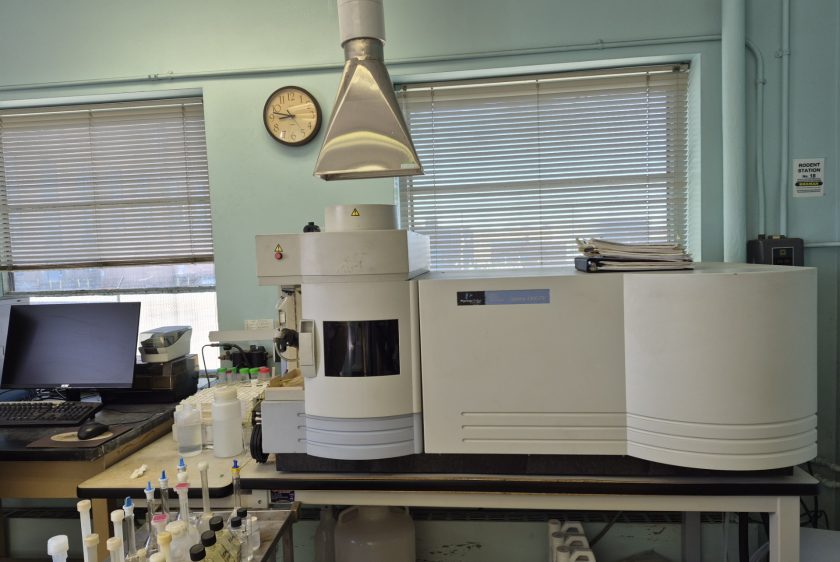
6. Laboratory Methodology: ICP-OES and ICP-MS Precision
At Sterling Analytical, we utilize state-of-the-art spectroscopic techniques to identify and quantify minerals at the molecular level. Unlike basic ash testing, Biomass Minerals Analysis requires a sophisticated “Digestion” process before the sample can be analyzed.
Microwave-Assisted Acid Digestion
Because biomass is an organic matrix, the minerals are “locked” within the carbon structure. To analyze them, we must first destroy the organic matter. We use Microwave-Assisted Digestion with concentrated nitric or hydrochloric acid (Aqua Regia). This process breaks down the biomass into a clear liquid solution, ensuring that 100% of the minerals are “in suspension” and ready for the spectrometer.
ICP-OES (Inductively Coupled Plasma Optical Emission Spectrometry)
The digested liquid is aspirated into a plasma torch that reaches temperatures of 10,000 Kelvin (hotter than the surface of the sun). At this heat, every mineral element emits a unique “light signature” or wavelength.
Accuracy: We can simultaneously measure up to 30 different elements, from major nutrients like Calcium (Ca) to trace metals like Zinc (Zn).
Detection Limits: ICP-OES allows us to detect minerals down to the parts-per-million (ppm) level, which is essential for identifying “poisoning” agents in catalyst-based systems.
ICP-MS (Mass Spectrometry) for Ultra-Trace Elements
For projects requiring even higher sensitivity—such as detecting Mercury (Hg) or Arsenic (As) for environmental permits—we utilize ICP-MS. This technology counts individual ions, allowing for detection at the parts-per-billion (ppb) level.
7. Trace Elements and Catalyst Poisoning in Biorefineries
As the bioeconomy shifts toward Advanced Biofuels (Sustainable Aviation Fuel, Green Hydrogen, and Renewable Diesel), the role of minerals becomes a “Make or Break” factor for plant profitability.
Many advanced conversion technologies rely on noble metal catalysts (Platinum, Palladium, Nickel). These catalysts are incredibly efficient but also incredibly fragile. Trace minerals in the biomass feedstock can “blind” the active sites of the catalyst:
Silicon (Si): Can form a glass-like coating over the catalyst surface.
Phosphorus (P): Reacts with the metal centers of the catalyst, permanently deactivating them.
Alkali Metals (K, Na): Can migrate into the catalyst structure, causing physical cracking or “sintering.”
By providing a detailed Biomass Minerals Analysis, Sterling Analytical helps biorefinery engineers design “Pre-Treatment” systems (such as water washing or acid leaching) to remove these “Catalyst Poisons” before they reach the expensive reactor beds.
8. Sampling Protocols: Avoiding "Tramp" Contamination
When testing for minerals at the ppm level, the “Cleanliness” of the sampling process is paramount. “Tramp” contamination—non-fuel materials introduced during handling—is the most common cause of skewed mineral results.
Soil and Sand: If a front-end loader scrapes the dirt floor of a fuel yard, the Silica (Si) and Aluminum (Al) levels in the sample will skyrocket. This leads to an incorrect prediction of high-temperature slagging.
Metal Wear: Samples taken from the very end of a brand-new auger or conveyor may show artificially high levels of Iron (Fe) or Chromium (Cr) due to “break-in” wear of the machinery.
Container Purity: Never use galvanized buckets or metal cans for mineral samples, as they can leach Zinc or Iron into the biomass. Always use high-density polyethylene (HDPE) bags or specialized laboratory-grade containers.
The “Composite” Requirement: Because minerals are often concentrated in the bark or the “fines” (small particles) of a biomass pile, your sample must be a representative composite of the entire fuel stream.
9. The Economic Impact: Why Mineral Data Saves Money
Investing in a Biomass Minerals Analysis is not just a scientific exercise; it is a direct contribution to the bottom line of a power plant or pellet mill.
Reducing Additive Costs
Many plants use “Slag Inhibitors” like Magnesium Oxide or Kaolin. Without a precise mineral profile, operators often “over-dose” these chemicals to be safe. By knowing your exact Potassium (K) and Sodium (Na) levels, you can optimize your additive injection rate, potentially saving tens of thousands of dollars in chemical costs annually.
Avoiding "Hazardous" Disposal Fees
If your ash contains high levels of Lead (Pb) or Cadmium (Cd) due to contaminated feedstock, it may be classified as hazardous waste. Hazardous landfill fees can be 5x to 10x higher than standard industrial waste fees. Identifying these minerals in the feedstock allows you to reject the contaminated load before it ever enters your system.
Maximizing Ash Revenue
If our analysis proves that your ash is rich in Phosphorus and Potassium and low in heavy metals, you can sell that ash to local farmers or fertilizer blenders. This transforms a “Disposal Cost” into a “Product Sale.”
Biomass Heating Value Analysis: The Science of Energy Density
Sterling Analytical delivers advanced Biomass Heating Value Analysis designed to precisely determine the true energy density of biomass fuels. Our testing evaluates key performance factors including calorific value, fuel consistency, and combustion efficiency across a wide range of materials such as wood waste, agricultural residues, pellets, and bioenergy feedstocks.
With accurate, data-driven insights, we help engineers, producers, and energy developers optimize fuel quality, enhance system performance, and make confident decisions for power generation, heating applications, and sustainable energy solutions.
Take the Next Step with Expert Biomass Testing
Frequently Asked Questions
Yes. Chromated Copper Arsenate (CCA) treated wood will show massive spikes in Chromium (Cr), Copper (Cu), and Arsenic (As). Our minerals analysis is the standard method for verifying the purity of "Clean Wood" recycled streams.
They use similar technology (ICP), but the preparation is different. A soil test looks for "available" nutrients, while our Biomass Minerals Analysis looks for the "Total" mineral content. This is necessary because combustion releases all minerals, not just the water-soluble ones.
If biomass (like straw) is left in the field and rained upon, the water-soluble minerals—specifically Potassium (K) and Chlorine (Cl)—will "leach" out. This actually improves the fuel quality. Our analysis can quantify how much "Natural Pre-Treatment" has occurred.
Phosphorus is a "double-edged sword." It is a valuable nutrient for ash recycling, but in the boiler, it can react with calcium to form low-melting-point phosphates that contribute to hard, "cement-like" fouling.
Quick Contact
If you have any questions or need help, feel free to contact with our team.
Send Us Email:
Call Us Today: